The Kitchen Bin, and What a Week Throws Away
The perimeter comes indoors once, at the kitchen, because that is where the outside is trying to get to. The bin is the reason.
The stop
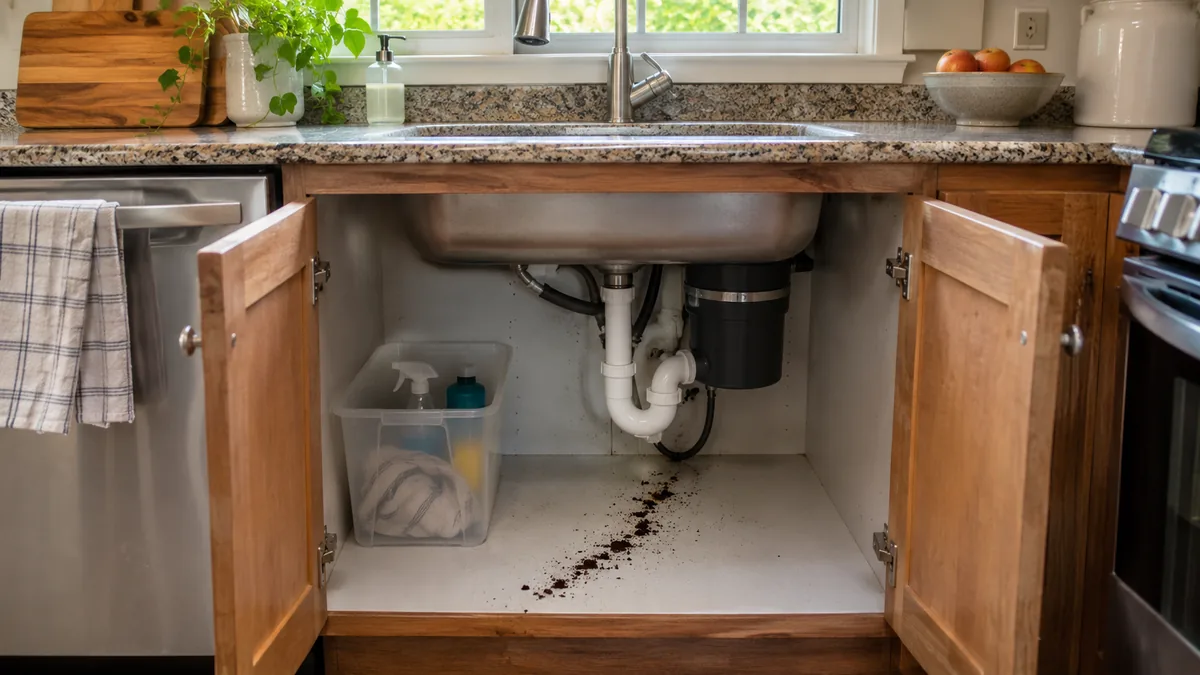
Every insect that comes into a kitchen comes for the same two things, food and water, and the cabinet under the sink offers both in one place. There is the drain pipe, which sweats, and the gap in the cabinet floor where the pipe goes through, which is a highway from the wall void. And there is the bin, which on this house had no lid, sat against the pipe, and had a crust of old grease on the cabinet floor behind it that nobody had seen because nobody had pulled the bin out in a year.
I can tell a lot about a kitchen from its bin before I ask a single question. A bin full of peels, bones, coffee grounds and eggshells belongs to a house that cooks, and it draws fruit flies and ants. A bin full of foil trays, pizza boxes and sauce packets belongs to a house where the food arrives finished, and it draws cockroaches, which prefer grease and cardboard glue to a banana skin. This one was the second kind, with a layer of the first kind at the bottom from the weekend.
What I do here is seal the gap around the drain pipe with copper mesh and sealant, scrape and clean the cabinet floor, put a gel bait at the back corner where the ants were trailing, and leave a station behind the kick plate. What I ask the owner for is simpler and matters more: a bin with a lid that closes on its own, a liner changed every night the kitchen is used, the rim of the bin wiped when the liner comes out, and the bag taken outside before bed rather than in the morning.
The note
A bin is the most honest record in a house. It does not care what anyone meant to eat. It holds what was actually eaten, in the order it was eaten, with the time of day written in the layers. When I pulled this one out, the top layer was a takeout container and two energy drink cans, and under them was the breakfast nobody had finished. The owner said, a little embarrassed, that most nights he ate standing at the counter after ten, because that was when the house was finally quiet.
I did not comment on that, because it is not my trade. But I will write down the observation, since he asked me to. Research has looked at what time a day's last meal lands and how the night after it goes, and the general shape of it is that a late, large meal and a good night do not often share a bed. Some men notice that a kitchen that closes at a fixed hour, with the bin tied and the lights off, closes the day with it, and that the next morning arrives lighter.
The habit I would suggest is the lid. Not as a pest measure, though it is one, but as a signal. When the bag goes out and the lid comes down, the kitchen is shut for the night. Whatever a man wants to eat after that hour, he wants it more than he needs it, and the lid gives him a second to notice the difference. On trash day, look at the bag before it goes to the curb. Count the cans. Nobody else will, and nobody else needs to; it is a private weekly reading that no scale provides.
The ants were mine. The lid was his. He bought one the same afternoon, which is more than most people do on the day of a visit, and the station behind the kick plate has been empty since.
Worth asking a doctor about
If a man's weight has moved in either direction without him trying, if appetite has changed in a way he cannot explain, or if eating late brings burning in the chest or throat that keeps him from lying flat, the bin is not where that question gets answered. A physician is.