The Crawlspace Vent, and the Air in the Room Where He Sleeps
The vent is the size of a shoebox lid. What passes through it decides more than the man asleep above it would guess.
The stop
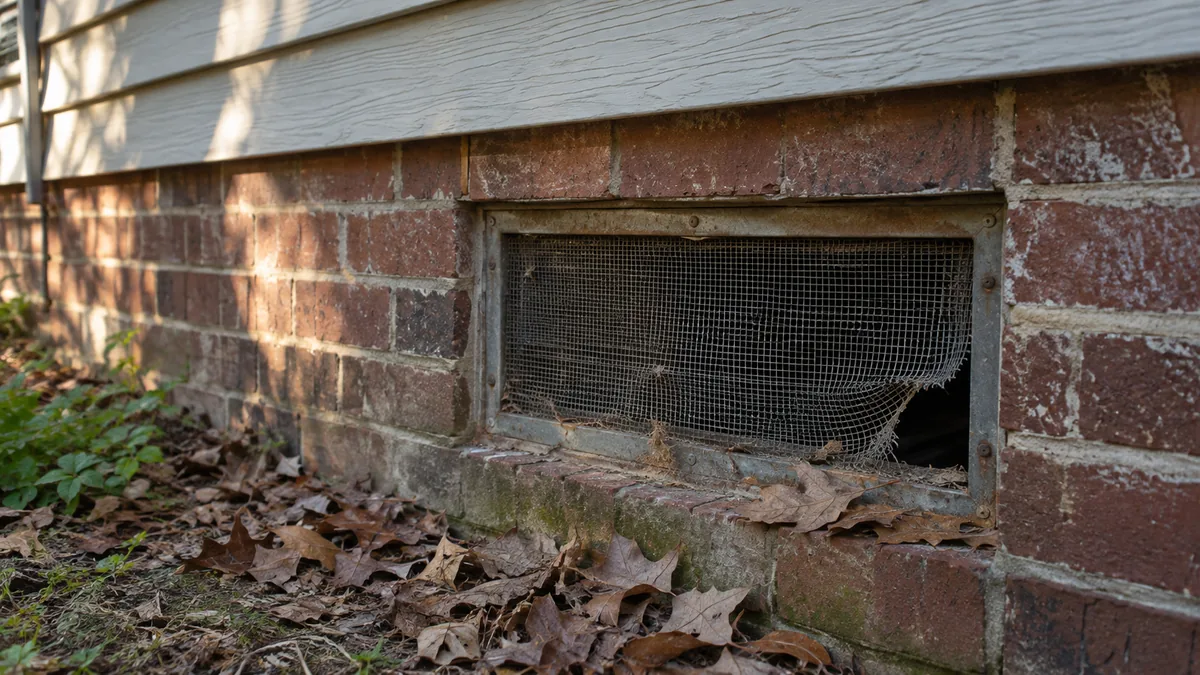
I start a perimeter on the shaded side, because that is where the ground stays wet longest and where the vents are most often forgotten. This one sat a hand's width above the soil. Leaves had banked against it. The wire screen had a tear in the lower corner the width of two fingers, which to a mouse is a front door and to a wasp is an invitation to build in the dark.
A crawlspace vent exists to let air move under the floor so the joists stay dry. When the screen fails, it also lets in whatever is small enough and curious enough. I look for four things at a vent: the state of the screen, the gap between frame and masonry, dark stains on the sill that say water pools there, and droppings or shed wings on the ledge. This one had three of the four. Under the house, with the flashlight, the soil was damp to the touch and there was a run along the inside of the foundation where something had been travelling for a while.
The fix is not dramatic. New screen, galvanized, stapled tight and sealed at the edges. Leaves cleared and the soil pulled back so the vent breathes. A monitoring station placed inside, just past the opening, so the next visit tells us whether the run is still in use. If the ground under a house stays wet, the ground gets graded or a vapor barrier goes down, but that is a separate job and a separate conversation with the owner.
The note
Here is the part that is not about pests. Air under a house does not stay under the house. Warm air inside rises and leaves through the top floor, and the pressure it leaves behind pulls air up from below through every gap in the subfloor. The crawlspace is, in a quiet way, the intake for the rooms above it. The room above this vent was the bedroom. The man who slept there told me he kept the window shut through every season because the street was noisy and the pollen was bad, and that he woke most mornings with a dry throat and a head that took an hour to clear.
I am not a doctor and I did not offer him a diagnosis. I offered him the observation that the first air he breathed every morning was the air of a closed room sitting over a wet crawlspace. Some men feel the change inside a week of altering that one thing. Research has looked at the bedroom as a place where air quality and the sense of being rested go together, and the plain version is that cooler, moving air tends to be rated better by the people sleeping in it than warm, still air, regardless of what the thermostat says.
The habit, then, is small. Open the bedroom window an inch at night, or if the street truly will not allow it, leave the bedroom door open so the room is part of the house instead of a box inside it. Pull the bed a hand's width off the wall so air moves behind it. Once a season, take the grille off the floor register in that room and wipe it, because the dust that settles there is the dust the room breathes. And in the morning, before coffee, before the phone, stand at an open door for one full breath of outside air. It costs nothing and it tells the body which side of the night it is on.
The vent was my job. The window was his. Neither of us could do the other's, and both of them were worth doing.
Worth asking a doctor about
If a man snores loudly enough to be heard through a wall, wakes gasping or with a pounding heart, or feels unrested after a full night more days than not, that is not a vent question and not a window question. It belongs to a physician, and a cracked window is not a reason to wait on the appointment.